- When will Barcelona’s La Sagrada finally be finished?
- Who designed La Sagrada Familia?
- What is the Tower of Jesus Christ?
- Why will Pope Leo XIV visit La Sagrada Familia in June 2026?
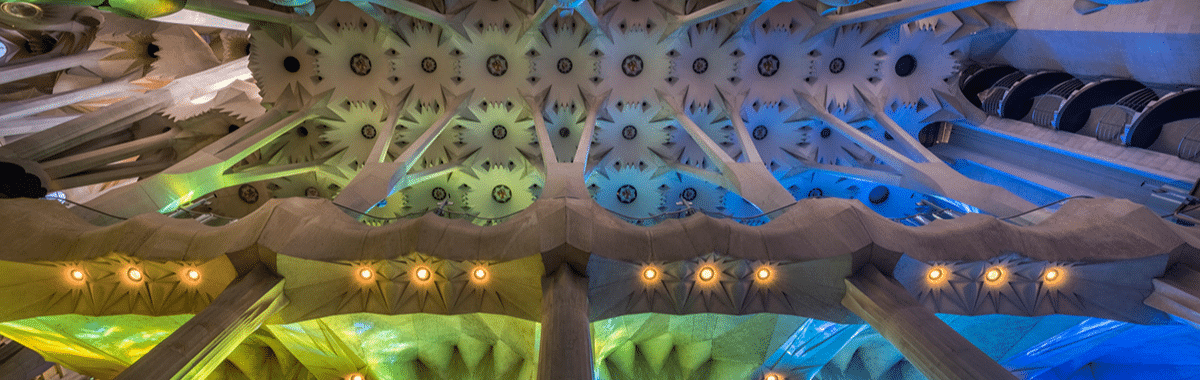
Barcelona’s iconic La Sagrada Familia (pictured above is its glorious interior stained glass) is now the world’s tallest church after reaching an important milestone. The 144-year-old construction project, which has been stalled by disasters, civil war, and political jousting, is now about 80 percent complete.
The Tower of Jesus Christ is the last piece of its central tower. The 56-foot-high steel and glass cross was installed in February 2026, extending La Sagrada Familia’s height to 172.5 meters, surpassing Germany’s Ulm Minster (162 meters). That was a key moment in the long, turbulent history of this marvel, designed by Barcelona’s iconic architect Antoni Gaudi.
And its next key milestone? On June 10, 2026, a date that marks the 100th anniversary of Gaudi’s death, Pope Leo XIV is visiting La Sagrada Familia to celebrate the completion of The Tower of Jesus Christ. Pope Leo XIV will officiate a special mass inside the church on that day and also lead the blessing and inauguration of its recently installed cross.
Moving forward
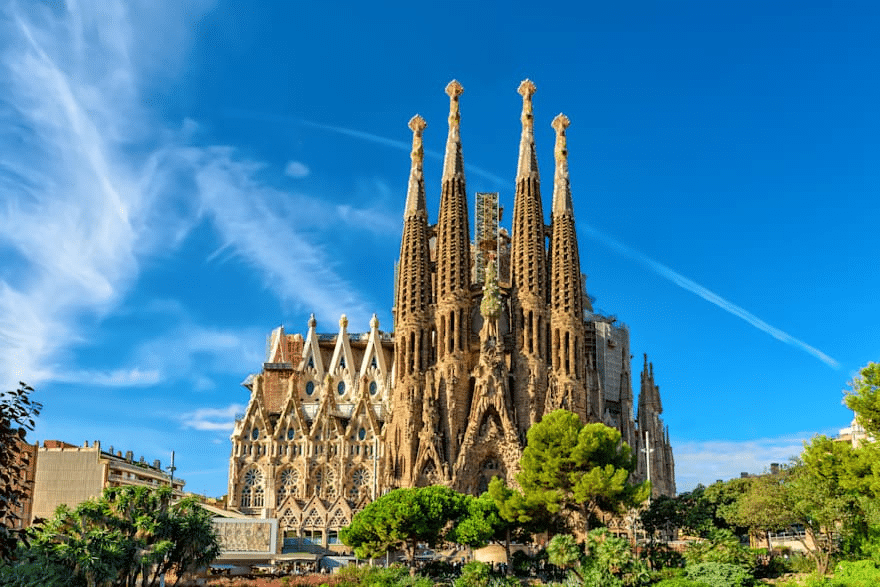
Meanwhile, construction will continue on this church for another decade, focusing on the stonework of the Glory Façade, its towering main entrance. This church is so colossal and unique that it became the top attraction in one of the world’s most visited cities despite being a mere work in progress, often blighted by scaffolding. Only seven years ago, La Sagrada Familia was stuck at 60 percent complete, having barely advanced for decades.
But in 2019 Barcelona authorities belatedly approved the building permit that had long slowed this project. Progress has since accelerated to the point that this masterpiece is scheduled to be fully completed in about 2036. That will effectively celebrate the legacy of Gaudi, one of few architects in history to have a UNESCO World Heritage Site dedicated entirely to their works.
Barcelona’s tourist trail revolves around the seven whimsical Gaudi structures included in that UNESCO listing. From the green expanse of Parque Güell to quirky mansion Palacio Güell, and from the curvy wonder of Casa Mila to the polychromatic marvel Casa Vicens, no trip to Barcelona is complete without taking a Gaudi pilgrimage. And don’t miss other designs in Gaudi’s UNESCO listing, such as fierce-looking Casa Batlló and the eerie Crypt of Colonia Güell.
There’s more than meets the eye when it comes to Gaudi in Barcelona
What isn’t apparent to many of that latter landmark’s five million annual visitors is the array of controversies which have hindered it. The first of these arose in 1882. That is when La Sagrada Familia was first envisioned by its original architect, Francisco de Paula del Villar.
His proposal was a mundane, neo-Gothic design, similar to countless other churches in Europe at that time. Yet it was not this uninspired concept which derailed Francisco de Paula del Villar. Instead, he was fired in 1883 due to arguments with Barcelona’s Catholic leaders about material costs.
Within months, this veteran Spanish architect had been replaced by a fast-rising rookie. Gaudi was only 31 years old and had been an architect for just five years when he took charge of La Sagrada Familia. He abandoned Villar’s boring blueprints and unleashed his own inventive mind.
Gaudi’s concept was invigorating: a bold blend of Noucentisme (a Catalan cultural movement that was the opposite of Avant Garde), Art Nouveau, Catalan Modernism, and Spanish Late Gothic architectural elements. In an era when churches were austere and angular, he sketched a playful building with remarkably few straight lines and no right angles.
Gaudi wanted its exterior to be crested by 18 lofty towers, up to 172 meters tall that would, from a distance, resemble a dense forest. Up close, the church is equally distinctive. I have been awestruck by the intricate stonework of its façade, with epic biblical scenes complemented by depictions of fruit, landscapes and geometric motifs. Once inside, Gaudi’s nature theme continues, with 36 giant columns rising to the roof like mighty trees, each bathed in rainbow-hued light from complex stained glass windows.
Bringing all these layers of design to reality was an obsession for Gaudi. But when he died in 1926, the basilica was still less than half finished. Although construction continued thereafter, this project began its long period of delays in 1936, with the eruption of the Spanish Civil War. Not only did work on the church have to slow down because of this three-year conflict but anarchists also damaged La Sagrada Familia and destroyed many of Gaudi’s plans and scale models, further limiting its progress.
From the 1940s to the 1980s, it moved ahead at a glacial pace due to funding shortages and a revolving door of architects commanding the project. Since then it has hit further obstacles in the form of an underground train tunnel being bored alongside the church, ongoing disputes with Barcelona City officials about building permits, and the Covid-19 pandemic.
Nowadays, controversy still hangs low over this tall structure. The addition of a giant outdoor case is likely to take another eight years and is expected to require the eviction of up to 3,000 disgruntled residents from neighboring streets.
Even if you’ve already visited La Sagrada Familia in Barcelona, it’s worth a return to see the Tower of Jesus Christ
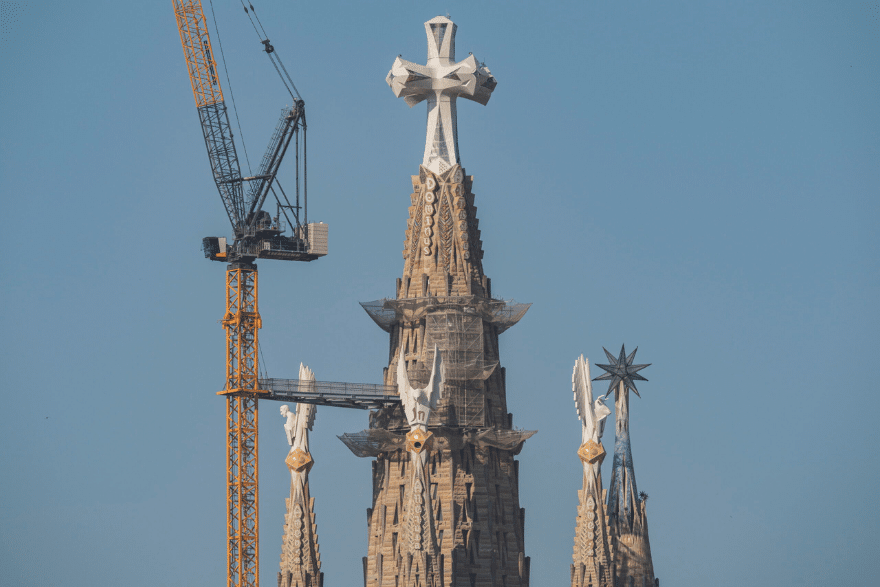
For now, of course, the focus is on the recently installed Tower of Jesus Christ. This lavish, 17-meter-tall cross is crucial for a variety of reasons. First, it crowns this lofty building. Secondly, this tower’s design, decorated by trencadis (a unique style of mosaic that uses shards of glass or ceramics; it’s a familiar signature across the city of Gaudi’s style).
As well, the design of the Tower of Jesus Christ offers a new visual spectacle visible from many parts of Barcelona, by day or night. In the sunlight its mosaics glimmer, sending rainbow-hued beams across Barcelona. After dark, its mighty spotlights let the cross glow like a star.
Lastly, and perhaps most importantly from a visitor’s perspective, the tower will eventually be accessible to visitors. Via the new outdoor staircase, you’ll be able to ascend to the highest viewing platform in all of Barcelona, gaining panoramic vistas of its historic cityscape, pretty beaches, and nearby peaks.
What else is new about La Sagrada Familia?
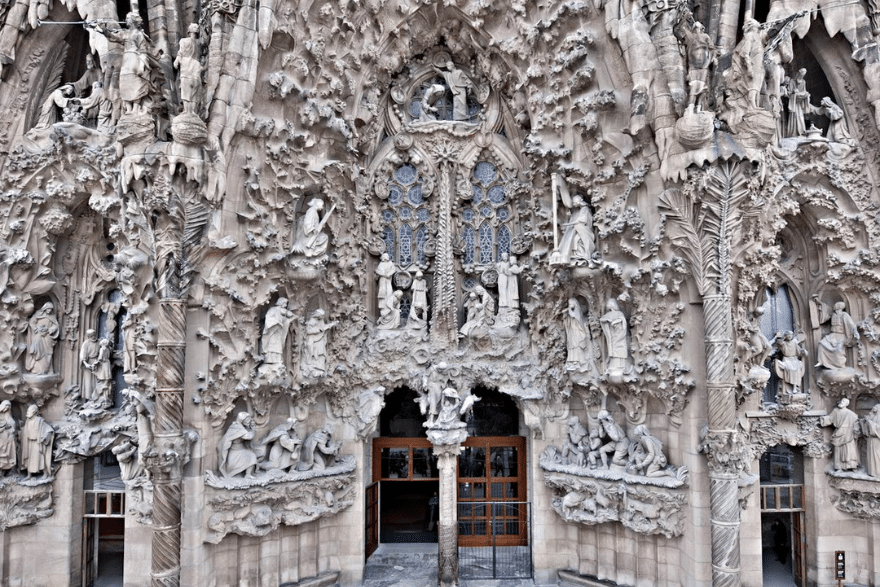
The four stone spires that surround the Tower of Jesus Christ were completed across 2022 and 2023. Measuring 135m apiece, they are variously dedicated to the Four Evangelists from Christian tradition: Matthew, Mark, Luke, and John. Biblical characters and themes also decorate the church’s three facades, below the spires. Each of these intricate displays of stonework represent a different phase in Jesus’ life. The son of god’s birth is portrayed on the Nativity Façade, his crucifixion and resurrection are depicted by the Passion Façade, and his enduring impact on the world is represented by the Glory Façade.
Each is a lasting, and mesmerising marker of Gaudi’s genius. So unusual and evocative was his concept for this basilica that, 143 years later, it still appears fresh and inspired and stands out amid Europe’s vast array of grand churches. Even a century marred by war, pandemic, budget crises, and bureaucratic roadblocks could not prevent La Sagrada Familia from reaching its dazzling, tallest form.
And in June, its bold creator will be remembered, celebrated, and honoured, 100 years to the day after his death. Of course, we’ll continue to celebrate this bold accomplishment well after the June visit of Pope Leo XIV.
Inspired to travel? Our hints and tips.
- Barcelona is one of Windstar’s hub home ports, and its ships embark and/or disembark in the city all four months of the year. The good news? Travelers who arrive a few days early to explore the city (or extend their trip at the end of the cruise) can visit not just La Sagrada Familia but also Gaudi’s numerous other feats of architecture. However, one note: Very few itineraries include Barcelona as a regular port of call so you’ll want to plan your own explorations.
- There’s a huge range of Mediterranean itineraries that Windstar visits via Barcelona, including: Quick Getaways: Balearic Islands and Port Vendres; Moroccan Markets and Iberian Icons; Windstar’s 2026 Mystery Cruise, with its focus on Spain; Yachtsman’s Harbors of the Rivieras; Star Collector: Riches of the Rivieras, Romans and Greeks and Europe, a Winter Riviera. Even more options exist; click here.
- Fascinated by all-things-Sagrada Familia? This blog, produced by the Basilica Sagrada Familia, is one of our favorite reads for everything from history to actual construction.
- And one last insight: Antoni Gaudi grew up in Reus, about 18 minutes outside of Tarragona, a Roman city quite close to Barcelona. If you want to understand more about what, in his young life, inspired him about architecture, read this. And Windstar does offer an itinerary that starts in Tarragona (about an 1:15 hour drive from Barcelona), a newly emerging home port in Spain.